
Retention is not only a compensation or culture issue. It is a workforce-capacity decision, and benefits employees can actually access are part of the economic equation.
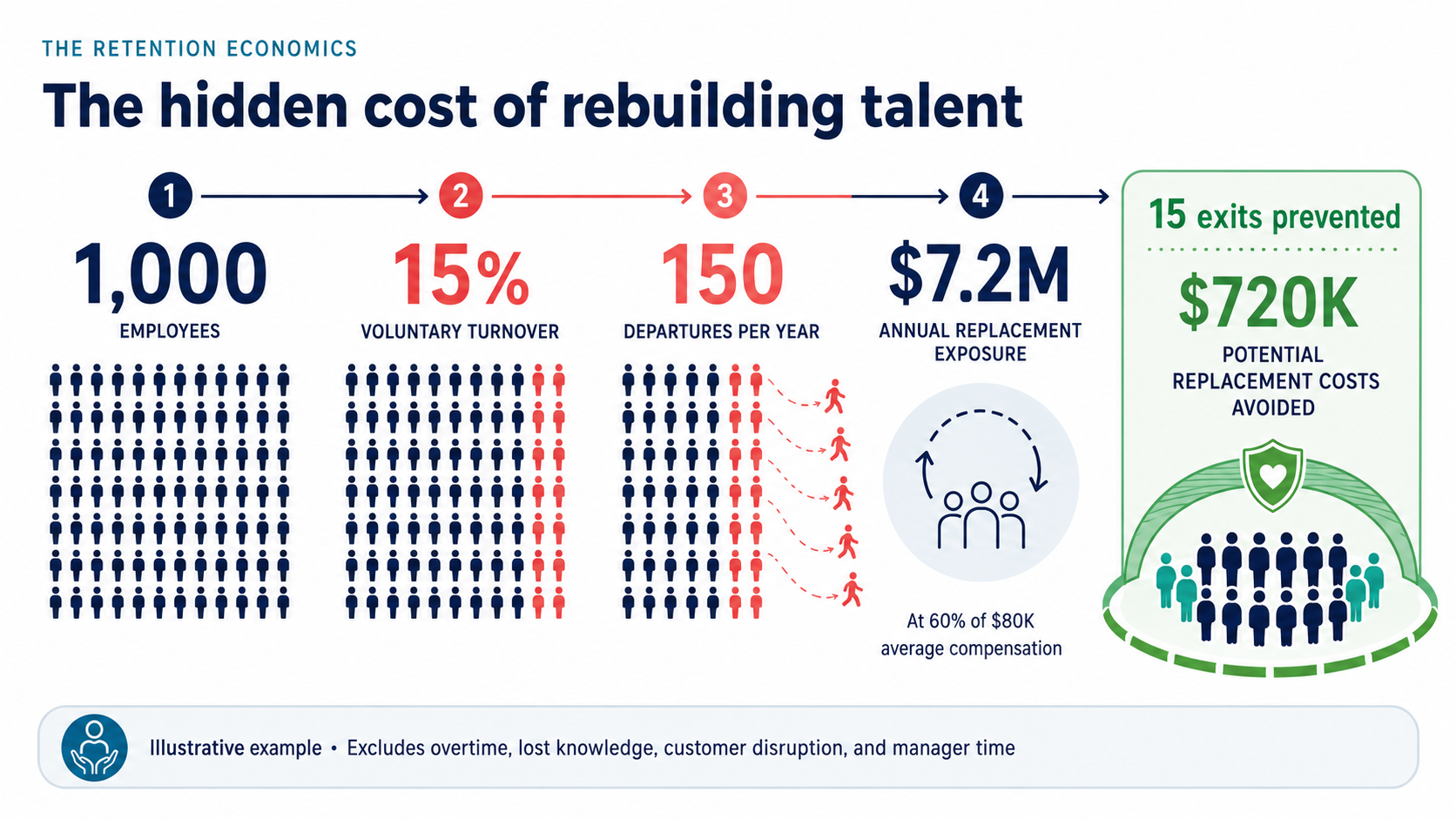
EXECUTIVE TAKEAWAY: A 1,000-person organization with 15% voluntary turnover and $80,000 average compensation can face an illustrative $7.2 million in annual replacement exposure at a 60% blended cost assumption.
For many leadership teams, turnover appears in separate budget lines: recruiting, overtime, onboarding, training, temporary labor, and manager time. That structure hides the larger business event. When a capable employee leaves, the organization loses productive capacity and then pays to rebuild it. The cost can touch margin, customer continuity, execution speed, team stability, and growth. The retention conversation therefore should include not only how people are managed, but also whether employees can address health needs before those needs become absences, burnout, or another reason to leave.
The Cost Stack Is Bigger Than Recruiting
SHRM’s 2025 benchmarking research reports an average cost-per-hire of $5,475 for nonexecutive positions and $35,879 for executive positions.[1] SHRM also reports an average time-to-fill of approximately six weeks.[2] During that interval, work is delayed, redistributed, or covered at a premium. Once a candidate accepts, the company still must onboard, train, and wait for full productivity. Training magazine’s 2025 industry report estimates average expenditure of about $874 per learner across surveyed employers.[3]
Replacement costs rise further when vacancy losses, ramp-up time, customer disruption, lost knowledge, and pressure on remaining employees are included. Gallup estimates that replacing a frontline employee costs roughly 40% of salary, a technical professional about 80%, and a leader or manager around 200%.[4] Every avoidable exit therefore creates a hurdle rate for retention investment. If a practical intervention helps preserve a high-value employee’s capacity, the economics can be meaningful.
Benefits Have Value Only When Employees Can Use Them
This is where benefits strategy can underperform. Employees may still face long waits, limited providers, inconvenient schedules, transportation barriers, confusion about where to begin, or privacy concerns. A benefit that exists on paper but is difficult to access has limited value to the employee and limited strategic value to the employer. HealthCues is designed to reduce that friction through multiple entry points. Depending on the program, employees may have access to health assessments, health and behavioral coaching, teletherapy, 24/7 telemedicine, preventive screenings, health education, digital health resources, and supplemental benefits. The value is not simply the number of services offered. It is giving employees a practical next step when a health concern, stressor, or question appears.
Turn Access Into a Retention Asset
Different services create value in different ways. Assessments can help identify concerns earlier. Coaching can support stress management and healthier habits. Teletherapy can make behavioral-health support easier to reach around work and caregiving. Telemedicine can reduce unnecessary travel and time away. Screenings and education can encourage earlier awareness, while digital resources can make the program easier to navigate.
For executives, the more useful definition of benefit value is not how many products sit in the portfolio, but how effectively employees can move from “I need help” to an appropriate resource. That matters especially for shift workers, remote employees, caregivers, rural populations, and employees with limited local provider access. When support is convenient, understandable, and trusted, the employer’s investment becomes more visible in the employee experience.
Protect Capacity Before a Resignation
Gallup’s 2026 update found that 42% of employees who voluntarily left during the prior year believed their manager or organization could have done something to prevent the departure.[4] A HealthCues analysis also identifies excessive workloads, inadequate staffing, unpredictable schedules, poor communication, limited job control, and lack of manager support as common workplace stressors.
Benefits cannot solve those operating problems. But accessible health support can address a different part of the risk: employees dealing with stress, sleep problems, anxiety, caregiving pressure, or physical-health concerns that begin to affect focus, attendance, and performance. Earlier access can provide more options before a manageable issue becomes a longer absence, a crisis, or a decision to leave.
Build a Two-Layer Retention Strategy
The strongest retention strategy has two layers. The first is healthy work design: reasonable workloads, adequate staffing, clear expectations, capable managers, psychological safety, and flexibility where the work permits it. The second is accessible whole-person support. HealthCues fits in this second layer by helping employers make preventive, behavioral, and virtual-care resources easier to find and use. Together, the two layers address both the conditions of work and an employee’s ability to manage health needs while remaining productive and connected.
Quantify the Retention Economics
Consider an illustrative 1,000-person business with average annual compensation of $80,000 and 15% voluntary turnover. That equals 150 departures a year. If blended replacement cost is conservatively modeled at 60% of salary, annual turnover exposure is $7.2 million. Preventing only 15 exits would avoid approximately $720,000 in replacement costs before considering customer relationships, revenue protection, reduced overtime, or management distraction. The point is not to attribute every retained employee to a health benefit. It is to establish an investment test: where are replacement costs, absence, burnout, access barriers, or benefit confusion most visible, and what would it cost to improve support for those populations? HealthCues can then be evaluated against specific workforce-capacity risks rather than as a generic wellness expense.
Make the Benefits Experience Visible
A strong program also has to be understood. Employees need clear communication about what is available, how to access it, whether participation is voluntary, and how personal information is protected. Leaders should treat benefit navigation and communication as part of the product. The same principle applies in recruiting: a list of benefits is less persuasive than a credible explanation of how employees can actually obtain care around work and family demands.
Use an Executive-Grade Scorecard
The C-suite should measure workforce outcomes and benefit performance together. Track regrettable turnover, first-year attrition, time-to-fill, absence, disability duration, internal mobility, and time to proficiency. Then add benefit awareness, utilization by service, access time, employee-reported ease of use, and results by location, shift, or job family. The goal is not maximum utilization of every service. It is appropriate use, earlier access, and evidence that support is reaching the populations where it can create the most value.
Where HealthCues Fits
The executive decision is not whether benefits alone can fix retention. They cannot. The question is whether the organization is paying repeatedly to rebuild talent while employees face avoidable friction in getting support.
HealthCues gives employers a practical way to strengthen the support side of the retention equation through preventive care, behavioral-health resources, teletherapy, telemedicine, coaching, screenings, education, digital tools, and supplemental benefits. Combined with responsible leadership and healthy job design, that makes benefits more than an expense line. It makes them part of a strategy to protect workforce capacity, demonstrate value to employees, and reduce the cost of rebuilding talent.
SOURCE NOTES
Research and Benchmark Sources
Current benchmarks were checked against publisher or institutional sources available as of August 4, 2026.
[3] Training Magazine. “2025 Training Industry Report.” November 10, 2025.
[4] Gallup. “42% of Employee Turnover Is Preventable but Often Ignored.” Updated February 16, 2026.
[5] World Health Organization. “Mental Health at Work.” Fact sheet updated September 2, 2024.
[6] Gallup. “The Economic Cost of Poor Employee Mental Health.” December 13, 2022.
[7] Gallup. “State of the Global Workplace 2026.” Published 2026.
Editorial note: Benchmarks are directional and should be supplemented with company-specific data on role mix, compensation, vacancy duration, time to proficiency, productivity, customer impact, and avoidable turnover.