
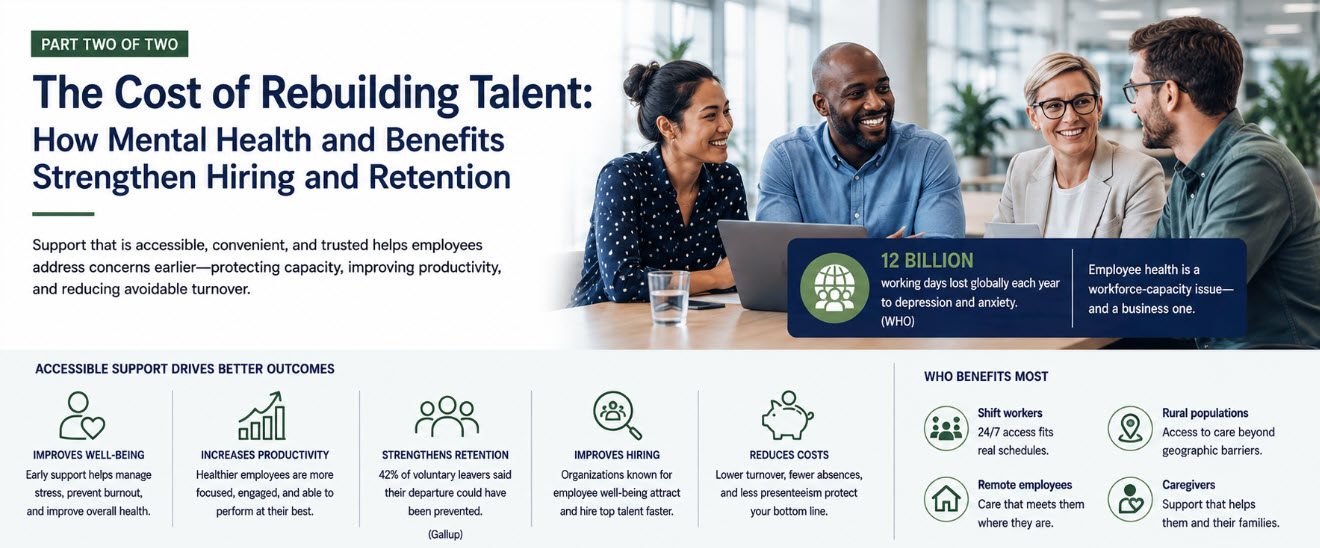
Hiring, benefits, workforce health, and operating conditions form one employee experience. Managing them together can reduce avoidable talent loss and protect productive capacity.
EXECUTIVE TAKEAWAY: Accessible care can strengthen retention and hiring only when it complements responsible staffing, reasonable workloads, capable managers, and clear privacy protections.
Retention and hiring are usually managed as separate activities. Recruiting fills vacancies; benefits manages coverage; operations drives output; finance controls labor cost. Employees experience them as one system. The conditions under which they work, the support they can access, and the credibility of the employer’s promises shape whether they join, perform, and stay.
Capacity Is More Than Headcount
The macroeconomic cost of poor mental health is substantial. The World Health Organization estimates that depression and anxiety cause 12 billion lost working days globally each year and approximately $1 trillion in lost productivity.[5] In the United States, Gallup found that workers who rated their mental health as fair or poor reported nearly 12 unplanned absence days annually, compared with 2.5 days for other workers. Gallup estimated the resulting lost productivity at $47.6 billion a year.[6]
These figures matter to hiring because a vacancy is not the only capacity problem. A company can be fully staffed on paper while losing output through absence, presenteeism, burnout, errors, and disengagement. Gallup’s 2026 State of the Global Workplace report found global employee engagement at 20% in 2025 and estimated that low engagement cost the world economy about $10 trillion, or 9% of global GDP.[7] These global figures are not a forecast for one company; they signal that workforce capacity depends on more than headcount.
Make the Employer Value Proposition Credible
Mental health also influences the employer value proposition. Candidates evaluate salary, workload, flexibility, manager quality, health coverage, access to care, and whether the culture appears sustainable. An employer that advertises well-being while tolerating chronic overload creates reputational risk. An employer that combines responsible work design with usable health resources gives candidates a more credible reason to choose the organization, and employees a stronger reason to remain.
Access Is the Product
Usability is the key distinction. The original HealthCues article correctly notes that offering benefits does not guarantee access. Employees may face cost concerns, long wait times, limited provider availability, transportation barriers, inflexible schedules, confusion, stigma, or confidentiality concerns. Gallup similarly found that 57% of U.S. workers could not confirm that easily accessible mental-health support was available through their employer: 24% said it was unavailable, and 33% did not know.[6] A benefit that employees cannot find, trust, schedule, or afford has limited recruiting or retention value.
For this reason, benefit strategy should be evaluated as an operating system rather than a catalog. The objective is to shorten the distance between an employee recognizing a need and receiving appropriate support. A coordinated model may include health assessments, behavioral and health coaching, teletherapy, 24/7 telemedicine, preventive screenings, health education, digital navigation, and supplemental benefits. Virtual access can be particularly valuable for shift workers, caregivers, rural employees, and people with limited local providers.
Measure the Mechanism
The business case should remain disciplined. No single benefit will eliminate turnover, reduce every medical claim, or repair a harmful workplace. Instead, leaders should define the mechanism they expect to influence. Faster access may reduce time away from work. Earlier intervention may prevent a manageable condition from becoming a longer absence. Navigation may improve awareness and use. Coaching may support sustained behavior change. Confidential behavioral-health access may help employees seek support before burnout becomes resignation.
Measure the system through a balanced scorecard. On the talent side, track applicant acceptance, new-hire retention, first-year turnover, time-to-fill, internal mobility, and regrettable exits. On the health and capacity side, track benefit awareness, utilization, access time, absence, disability duration, return-to-work outcomes, and employee-reported ability to obtain care. On the financial side, track direct recruiting cost, vacancy days, temporary labor, overtime, training, time to proficiency, and avoided replacement cost.
An executive dashboard should segment results. Companywide averages can conceal the populations experiencing the greatest friction. Review outcomes by location, shift, job family, manager, tenure, and workforce type. A telehealth program may produce limited change in a headquarters population with strong local access but meaningful value for rural sites or night-shift employees. Scheduling changes may matter more in frontline operations than in professional roles. Manager training may have the highest leverage where turnover clusters under specific leaders.
Trust Is a Business Requirement
Leaders should also protect trust. Employees are more likely to use mental-health resources when privacy, voluntariness, and data boundaries are clear. Communications should explain what information is collected, who can see it, what is reported to the employer, how to access urgent help, and how to opt in or out. Personal health information should never be used in employment decisions. A strong benefit can fail if employees believe participation will affect advancement or job security.
An Integrated C-Suite Agenda
The C-suite agenda is therefore broader than buying a program. First, diagnose where hiring and retention costs are concentrated. Second, remove preventable workplace stressors such as unreasonable workloads, inadequate staffing, poor communication, and unpredictable scheduling. Third, give managers the capacity and training to hold meaningful conversations, recognize performance, clarify priorities, and respond to concerns. Fourth, provide accessible whole-person health resources. Fifth, communicate them clearly. Finally, measure outcomes rather than enrollment.
Apply the Investment Test
This approach changes the investment question. Instead of asking whether the organization can afford another employee-health resource, ask whether the resource addresses a documented source of absence, turnover, or hiring disadvantage, and whether its cost is lower than the capacity it protects. For a critical employee whose replacement may cost 80% or 200% of salary, the threshold for a positive return can be surprisingly modest.
Where HealthCues Fits
HealthCues can support this strategy by helping employers connect employees with preventive, behavioral, and virtual-care resources through a more coordinated experience. Benefits do not replace leadership. It is that accessible care can complement healthier work design, reduce friction in seeking support, and strengthen the overall employee experience.
The Executive Conclusion
The executive conclusion: workforce health, hiring economics, and retention economics belong in the same conversation. Organizations that manage them together can make better benefit decisions, reduce avoidable talent loss, and build capacity without relying exclusively on repeated external hiring. In a market where every vacancy carries direct cost and every departure can disrupt performance, supporting employees earlier is not only compassionate. It is financially responsible.
SOURCE NOTES
Research and Benchmark Sources
Current benchmarks were checked against publisher or institutional sources available as of August 4, 2026.
[3] Training Magazine. “2025 Training Industry Report.” November 10, 2025.
[4] Gallup. “42% of Employee Turnover Is Preventable but Often Ignored.” Updated February 16, 2026.
[5] World Health Organization. “Mental Health at Work.” Fact sheet updated September 2, 2024.
[6] Gallup. “The Economic Cost of Poor Employee Mental Health.” December 13, 2022.
[7] Gallup. “State of the Global Workplace 2026.” Published 2026.
Editorial note: Benchmarks are directional and should be supplemented with company-specific data on role mix, compensation, vacancy duration, time to proficiency, productivity, customer impact, and avoidable turnover.